so today was a weird day. it was raining, even though it's been blizzarding for the past week. i sat down in my family room to do work, but eight hours later I stood up and realized I hadn't done a damn thing. I was so busy I didn't make it to the pharmacy last week, so I haven't been taking my long term insulin or my antidepressants... because I literally don't have any. I endured watching a Bears game and they got crushed by the patriots. But I was still content to watch football. Then I decided to watch Moon, which is a really great science-fiction movie. But I don't think I should have watched it in the mood I'm in. I definitely should not have watched the family guy holiday special. That was some fucked up shit--and did nothing to make me feel better. Weird fucking mood I'm in. My mind very easily gets derailed into fucking weird land. Which is why I started blogging, actually. Listening to Asteroid Field from the Empire Strikes Back and looking through Facebook, I suddenly got this painful feeling of deja vu and then I needed to mix things up. This really is a piss poor blog entry, but you can fuck off? NO!!!! JUST KIDDING! clap your hands say yeah
good stuff

Monday, December 13, 2010


Friday, December 10, 2010
Kill Me
It's racism. That's what I wanted to write about. Okay, so there's a lot of really annoying little things in my life. And what's perhaps most infuriating is that they're all fucking social issues. WHICH IS SO FUCKING FUCKED UP. I'm pretty sure the answer to most of my problems will be something like this:
I am a robot with mild asperger's syndrome.
SURPRISE! Anyway, social issues suck. Especially when they're racism. And especially when you're black. I don't like to think of myself as uppity. I am definitely sensitive. But I'm not as uppity about my race as homophobes are about their sexuality. SO WIN FOR ME. Or is that a stereotype? Who knows. All I know is it's great to watch people defend their heterosexuality for NO. APPARENT. REASON. Ridiculous. I couldn't care less if you were even a person. And I'm serious. For all I know, I'm the only person who actually exists. Or maybe I'm only the only robot. Okay, wait a second, this is clearly a rant. But it feels good to rant when you've been throwing yourself against the walls of your consciousness with theories of insidious racism that insure that you will always fail. And I mean always. Does it not matter that I am smart? Will I always question that just because I'm not white? Am I different because I'm not white? Hell, black or white, I'm still a robot. But that bothers me. Not that I'm a robot. I'm probably not a robot. But are there differences between me and white people that are so inconspicuous, yet divisive, that I will constantly fail?
Okay, well what if I could just forget that I was black? Then I'd just look at things not as ever continuing trends (like, for example, why short, meek, and stout white girls are somehow a hot commodity, and I am literally a 9 who is 5'10'' and only 160 pounds but am somehow always single?) and consider painful incidences just as what they probably actually are: fate. Random happenings that just happen and it's unfortunate that that's what's up, but sometimes life just sucks. And it should feel like life just sucks and not that there's some more evil social reasons behind this. I mean, it's not like everything bad in my life is caused by racism (like why that fucking white idiot in my physics class clearly is about as "bright" as a burnt bulb, and as daft as science majors at Colgate should be allowed to be, but yet manages to get awarded Colgate's top academic prize?), right?
Or maybe I'm wrong. Maybe this system is fucked up. I don't know. I've been reading two papers about female physicians. And it's making me think about being black. I think it's harder to be black right now than to be a woman, if only because, as a woman, you share something in common with the majority of people living on the planet. Being black makes me similar in some way to only 10% of the world's population. But anyway, the first paper I read was very encouraging. Stereotypes and biases cannot exist! Especially not in medicine! "The different needs of women for support groups reflect the persistent gap between reason and reality, for lingering tails of tradition prevent the attainment of true liberation for all."
I SHOULDN'T HAVE TO FEEL LIKE THERE ARE THINGS BEYOND MY CONTROL HOLDING ME BACK. I'm not a perfect human being. I wake up every day hoping I don't make anymore of the same mistakes that literally haunt me but I don't always know if I'll be able to avoid them. But I don't cry about these things. I feel god awful about them. I don't want to keep being a sucky human being. But I know I'll get better. I'm getting older and I'm definitely learning, albeit slowly.
What makes me cry is thinking that there won't be any change whatsoever. That I can apply myself and still fail. And that this cycle will happen again and again. That's what makes me cry until I can't speak the next day. And the sad thing is, that last sentence is true.
No, but what is really sad is, I know racism isn't that bad. I know it's not. But why, then, is it always the logical answer for situations I can't explain?
I want to write. I've been writing so much lately, but it hasn't been fun. Papers and such and more nonsense. Couldn't I just be graded on a conversation? I would gladly discuss the issues I've been studying over this entire semester. But no, I have to wrap everything up in this over-formalized format. Quite annoying. But I'm a good writer. That's not what's bothering me.
But something clearly is. Otherwise I wouldn't be writing. There is no need for me to be blogging. I should be writing. But I'm not. I'm blogging. And who the hell knows why.
But something clearly is. Otherwise I wouldn't be writing. There is no need for me to be blogging. I should be writing. But I'm not. I'm blogging. And who the hell knows why.
Tuesday, November 16, 2010
Rhetorical Analysis of Lilly Pulitzer
Also, what the fuck? I think you're falling prey to Lilly Pulitzer ridiculous rhetoric. They can't fucking be honest about anything. They over sell all their products verbally, even the ones that really do suck. EXAMPLE:
> "We don't do "solids" often but when we do, we suuuure exceed expectations. Oh, and we say that in the most humble way (wink, wink). Seriously, this is the most perfect cozy sweater dress with everything you'd expect from Lilly minus our print!"
Sounds like that dress would be fucking amazing. The way I expect it to look is: hugging the models curves, offered in white and a brownish-grey... a hazel maybe... made of a nice cashmere blend and turtle neckish.

But seriously? What is that? It's gross. That's what it is. The only accurate guess I had was turtleneck--and it's not even really a turtleneck. They bastardized it in the picture of the blue one with an actual turtleneck, creating some some incredibly weird, double layered thing that I don't think should count as a turtleneck. They should be modest about that, and none of that wink wink crap either. That's seriously one of the worst sweater dresses I've seen on the market.
The worst part is, they're trying to make you, a gullible shopper, spend $178 on this piece of crap. It's made of cotton and wool. There's no cashmere in that. They try to convince you that it's amazing, "we suuuure exceed expectations," but the truth is, they didn't and if you are convinced that this dress is worth buying, then you shouldn't be allowed a disposable income. I bet OLD NAVY has better sweater dresses than this fiasco. I'll be back in three minutes...
Fine, Old Navy didn't offer anything stunning, but here's a GAP dress you'd actually have a fighting chance of looking sexy in for $78. Saving you literally, $100, and you're super hot sexiness.
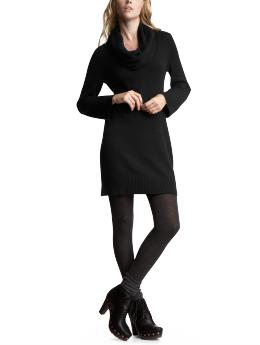
Seriously though, what the fuck? That's a sweater dress and it's super sexy and utilitarian. Best of all, it comes in appropriate winter colors such as black and dark purple, possibly a plum.
Best of all, GAP doesn't brag that it's created something; they don't trip over words to tell you that they've just created the "most perfect cozy sweater dress". They give you the straight facts: 51% Nylon, 41% Viscose Rayon, 8% Angora--Hand Wash--Imported. And it's also incredibly helpful in telling you how to best maximize your attractiveness in this rather costly (but still just $78) number:
"Incredibly versatile, our fine-gauge knit sweater dress looks best with tights and boots."
So straight and to the point. My GOD! Could shopping really be this easy?
And one last point I'd like to make:
Look back at the Lilly Pulitzer commentary for that dress.
Do you see it?
That horrific error?
It's a fucking exclamation point.
Don't buy things, or even converse with people, who use exclamation points regularly and without sarcasm in written communication. They're usually either batshit insane or completely fake, unrealistic, and out of touch with you, an actual person who is just trying to look good for as cheap as possible.
Right? You're an actual person who is just trying to look good for as cheap as possible.
I think that's an accurate statement to your identity. DON'T BUY CLOTHING FROM CRAZY PEOPLE.
ARE YOU TRYING TO LOOK SEXY OR ATTRACTIVE AT ALL?
Wednesday, November 03, 2010
NaNOwriMO?
It's November, so that means I'm doing it to myself again.
I'm writing. And I won't stop writing until I've hit 50,000 words or my words become completely unintelligible. Luckily, I'm doing most of my writing on a Microsoft word processor, so I'll know when the latter occurs. A sea of red will start over taking all my words, and I won't be able to right click quick enough...
HORROR OF HORRORS!
How much have I written so far? NOT NEARLY ENOUGH.
I don't know why I'm even telling you people this. I should have thought of a way to write this into my story... *IDEA!*
Gotta go!
Monday, October 25, 2010
KOL
There's something about Kings of Leon that makes you feel okay about feeling sad...
I'm going to stay in this mood until I pass out from the Unisom.
Or I'm going to jump ship when I change to another artist. (whazzzup trey songz?)
I don't like listening to sad music because there's so much uncertainty in emotions other than pure joy.
I'm going to go to sleep now.
Unisom is stronger than Benadryl.
I don't have a facebook anymore.
I'm tired.
love love love love love love love love love, love love love love, love love, love...
radioactive is a good song. a really good song. elora doesn't like the feelings she's feeling right now. but she respects and appreciates them...
Wednesday, October 20, 2010
Logical Lover
The other day I was probably doing something I wasn't supposed to be doing at that specific point in time. Unfortunately, I can't remember when this moment may have occured, and I can't be entirely sure that such a thing ever happened ever. I lose myself a lot. It's kind of like blacking out. Except you know you're conscious the entire time. But you're just not... there. I always imagined that this would happen for a brief couple of years after college when I just bummed around doing various sorts of low grade drugs. But it's happening right now and I don't know what to do! Where am I? What am I doing? Is this early-early-early-early-onset Alzheimer's? Is it senioritis? Is it seasonal affectiveness disorder? Is it the diabetes? The drugs? The depression? The lack of love? The lack of music? The lack of motivation? I don't know. I really can't tell. I want to be here right now. But I can't because everything just keeps on happening. Time keeps on slipping, and it's creepy as fuck. I don't know what I can do to remedy this. The harder I think about it, the more I get lost. So I guess I can only really ask you to help me do one thing, if you wouldn't mind too terribly much? Could you just... you know...
think about it?
Saturday, October 16, 2010
THIS IS WHY I IMBIBE: I AM NOT AN ALCOHOLIC PT. 1
you want to kill yourself? I did. But wait! There's alcohol. Alcohol puts everything in perspective. YOU ARE NOT THE CENTER OF THE UNIVERSE! You are one person. And everything that's happened to you has happened to at least one other person in the history of humanity. So cheer up! Ironic that you thought you were too forward and the two guys you had your sights on now have girlfriends? NO! That has had to have happened before! So cheer up! Because in the ancient times, the woman in your situation ended up with a King. Does that not cheer you up? That down the line there will be a man who is not only attractive (one of those guys), but also strangely similar to you in likes and dislikes (the other of those guys), and you will consummate the most amazing coupling ever witnessed in the area code of "847."
Yes indeed. Alcohol allows you to widen your perspective; to understand that even those things that seem unlikely are, nonetheless possible. If you doubt this: don't. I am drunk in this current moment. Just a few second ago I began to hiccup, and I began to feel bile building in my esophagus. But I never once doubted the wisdom of my words, because alcohol is the all-knowing substance that conquers all. I know people who prefer the equally agreeable cannabis to simple alcohol. Although I have only been "high" once, I must counter that I have never felt so logical and happy as I feel know. Alcohol is truly great, and potentially, the builder of civilization. Agriculture, that promoted civilization, and the creation of population-dense cities, may have been spurred by wo/mankind's need for staple crops that had the potential to create alcohol, such as wheat and barley.
Nevertheless, I digress. Key points: My heart has been broken. I realize now that I will never, in this year, be able to have the people, although there are only two, that I want. My dreams have been crushed, for I realize now that although I have been accepted into the medical school of my choice, I am still worried about what I will achieve in my remaining year at Colgate University, the school that has grown on me tremendously.
Life is a depressing gamble. You set your sights too low and you die accomplishing nothing. Set your sights too high and you die achieving few of your goals. But what is death? Today my pet turtle died, and I screamed and bawled and writhed on my kitchen floor, cursing my ineptitude. But s/he was dead, and there was nothing I could do. Death is but an end point. And as a rather intelligent fellow once told me, although I now hate his guts for leaving... "Life isn't great, but it's all we have", so I must acknowledge that I won't be able to achieve everything I've ever dreamed of.
But God, if you exist, or ELORA! I know you exist, and I know you can be strong when the need arises, PLEASE! Achieve the few goals that you care about. Today, one of your closest friends remarked that you cared primarily of "education" and "public health." Achieve your goals in these and you can forget that some many years ago you were humiliated and crushed when not one, but two individuals who you thought highly of for their attractiveness and similarities in world views decided to get girlfriends because you failed at likely the most important aspect of the three categories that governs Love, proximity: of proximity, similarity, and physical attractiveness.
God Bless You, elora apantaku. I wish you nothing but the best.
(dear audience, I am royally smashed, so goodnight to y'all).
"If you're ever suicidal,
don't forget to dial,
411 so they can prescribe'
some good vodka in a bottle!"
Friday, October 08, 2010
Alphabet Novel
A. A quick lesson in history: Rome was built in a day and God doesn't like the Danish.
B. "Because you went to see her, I missed picking up my laundry, and now I have nothing to wear tonight," she had said, thinking it would sound logical, even though I knew she only thought that because she was on the verge of a rage black-out and like her laundry, lost at the laundromat, had lost her critical thinking skills.
C. The child was standing by the side of the road, holding a stuffed animal--a giraffe to be specific.
D. Don't ever go to Safeway at night.
E. Every morning she went down to the little lake in their backyard, a pond really, and waded in to her knees or until the seaweed and pond scum started to curl around her ankles.
F. "Forget you and fuck this town." I hadn't seen him since.
G. George was an amiable character; at least that was what his wife wanted us to think, even though I knew he was an adulterer, a floozy, a cheapskate--a caricature of a charlatan.
H. He wanted very much, badly, to crash his fist into the pastel blue drywall, but last time that had happened, he had created a jagged hole and his mom had been very much, badly, displeased.
I. "I'm going to go off on a tangent now. I hope you don't mind...," was the first thing she had said when I walked into the room, and twenty minutes later she was still talking and I was still just nodding my head.
J. Just in case you decide you wanted to do something else with your life, I have some bad news for you: You're going to fail.
K. Katherine wanted pizza but everyone else in her circle of "friends" wanted Starbucks. She was now quiet but enraged, pondering the individual values of enjoying Sal's Pizzeria and loneliness or drinking coffee with contempt.
L. "Lose the shirt." She was always telling me what to wear, and I always listened. Until one day I decided, fuck it, I'm fourteen-years-old and I like the purple skinny jeans.
M. More than anything else in the entire world, Maria wanted to see the entire world disappear.
N. Nobody ever wanted to be "that kid"; however, Walt was now that kid, and he was skipping over the cracks in the sidewalk like a skier over moguls.
O. On clear nights, they said, you could see shooting stars. But they were lying so that people with stubborn dreams would take the time to go outside instead of sitting on their couches, watching late-night comedy shows. You couldn't see anything up there anymore. Light pollution, you know? There were no more stars for us.
P. "Personally, I never liked her," she had said but I knew that wasn't true and I knew that if she was older, more confident, and not such a fucking hypocrite she would've been able to tell everyone the truth. She was in love with Eva, but she couldn't be a lesbian, god forbid.
Q. "Queer as this may sound, I actually enjoy The Shins." I wanted to slap him, as punishment for his "queer" diction.
R. Rum should rarely be mixed with tequila--I learned that in a sloppy fashion one year and two months and one week ago.
S. She couldn't wait--she wouldn't be served, and Sheryl knew this but had come to the diner anyway, kind of sort of hoping to see the cute kid who was apparently fond of cappucinos, but more importantly, to symbolically say "fuck you" to her study group that would be meeting right about now.
T. The lights--the music--the tacky, bedazzled jean jackets--this was not the way my life was supposed to end up.
U. Ultraviolet would be the way he would describe her hair. He knew it didn't make sense--you can't see ultraviolet and you could see her hair, but yeah... you know.
V. "Very few people pass. In fact, so few people pass, we don't actually have a protocol for what to do now."
W. "Way down upon the Swanee River" is the song I always sing in my head when I go to visit the house where my cousin once lived before he jumped off a bridge into a lake to kill himself. I do not think that's an example of irony.
X. Xenophobic, cunt-licking bastards. Where was Reverend Jesse fucking Jackson when you needed him?
Y. "If you went there, you'd probably never make it back," she had said, with a squint in her right eye that he often mistook as a subtle, sexual advance, but as she popped her chewing gum he snapped out of it and remembered that Michelle must've been the dumbest bitch he knew.
Z. Zoos are not as safe as they say. If you spent more time in Zoos, you'd know that.
Tuesday, August 31, 2010
Pay Attention
For a short, immeasurable time, the stars in her eyes stopped spinning, and a subtle expression became apparent on the ridge that swept over her nose to the bottom of her lower lip, from ear to ear. But it vanished quickly. It must have been one of those small expressions--they had a scientific name. They were studied by mischievous academics trying to devise systems to seek out the mechanisms employed by the muscles in the faces of liars. Microexpressions. That's what they were called, I remembered, and they only lasted for a few hundredths of a second. To be viewed objectively, they had to be slowed down on camera. If I could only have recorded her face for that second, and extended it for an hour or two. See the sclera of her eyes fracture like cracked porcelain, see her pupils shrink, running away from reality, recessing into her retina. Or watch as the corners of her billowing lips plummet as if finally released from the tiresome job of keeping up a friendly front without so much as a promise of a pension pay check. Watch her nostrils flare by a quarter of a quarter of a half of an inch, in reflexive unison. To just see such beauty deteriorate under the basest of emotions--hate, fear, anxiety--I would have spent all day training a camera on her face. But as her stars regained their spin, she snapped past me, her feet most utilitarian in protecting her against my concern, against a question that would abuse me for the next few days, just as her microexpression would haunt me every time I looked at myself in a mirror. My features did not hold a comparable range of expressions. I could not briefly look as though I'd seen a tragedy unfolding over the shoulder of a friend. What had she seen? Had it been anything at all? Or was it something creeping out of the woodwork of her tortured mind? Would she tell me? Or would I have to watch her face slip out of its genial place at our every encounter?
Monday, July 19, 2010
The sky had been playfully teasing us with the possibility of rain for the last several hours. It was now mid afternoon, and even the howler monkeys were becoming frustrated, screaming out uncharacteristically without the ubiquitous sounds of a multitude of raindrops hitting the countless biomass protrusions that one could call leaves, though that would do a disservice to what they really were, drawing an unfair comparison to the oak and the maple and even the pine leaves of temperate regions.
Saturday, July 17, 2010
Her legs were folded underneath her as she sat straight up on their bed, staring at the small compact that came with her blush as it balanced on her left knee. Her iPod, or her Zune, whatever--her mp3 player was lying on the bed, pumping out music that he couldn't hear. He bet it was something angry. She didn't look up at him. He didn't try to catch her attention. She was applying eye-liner. She probably didn't want to hear him tell her she was putting on too much. She'd heard him tell her that almost every morning and every night she had ever put on make-up. Sometimes it didn't bother her. Sometimes she giggled. Sometimes she rolled her eyes. Once she began talking about the merits of putting on a good face, and the inequalities women have to deal with in western culture. He hadn't been ready for that conversation. But this morning she hadn't even responded when he walked behind her as she stood in front of the mirror. He had paused by the bedroom door for an extra moment, waiting for a response, and finding every muscle in his arms and face pulsating in anticipation of some grand fight--physical or verbal. But she would never have given him that, the pleasure of a resolution, no matter how unsettling, painful, bloody.
Saturday, July 10, 2010
Wednesday, July 07, 2010
Summer Novel... "Cassandra in a Concrete City"
The crack in the sidewalk was getting larger. Her foot could no longer cover it completely. Small leaves of grass were sprouting from above her big toe, separated from the four other digits on her right foot by the soft pink rubber of her $2 sandals. She loved the shoes. But Cassandra was still worried about the crack in the sidewalk.
It was definitely not OCD, but it was something. And although up and down the block there were probably dozens of concrete cracks digging deeper into the city’s center, this crack in particular had an above average significance to her. Tuesdays and Thursdays, and sometimes Saturdays when she walked down 17th before cutting over to Wallington and jumping on the red line, she would slow to a stop over the tannish block of melted rock and, while holding a disposable cup of tea or one of the city’s five free newspapers, mosey inconspicuously back and forth for however long it would take before she would be satisfied enough to walk slowly away.
Today she waited for ten or maybe eleven minutes. Half this time was spent shifting weight between her two legs, covered in black jeans. Today she had coffee. And the messenger bag she was using to replace her purse had been “tagged” by a friend in bright orange spray paint with some strange symbol he was unusually fond of—kind of like the way she felt unusually fond of the square. Her collection of accessories made her feel like an obnoxious art student, the ones you can spot without any of the usual amount of second guessing. They walked around like forgotten royalty but managed to simultaneously uphold the type of slouching posture which encourages wheelchair use later in life.
The majority of the other half of her ten or maybe eleven wasted minutes was spent examining the split. The heat of summer must’ve been convincing the ground to break up. Today it was only seventy-six degrees, but last week’s climate had broiled the city at above eighty day after day. It was completely the result of chemistry. There were reasonable scientific explanations for what was happening beneath her feet.
The final minute or two of her time was spent trying not to make eye contact with the dry cleaning woman in the store behind her. She knew. The woman knew that she always came to this spot on Tuesdays and Thursdays, and sometimes Saturdays. Miraculously, the woman, a middle aged Korean woman, was always in the dry cleaners; or at least, always in the dry cleaners on Tuesdays and Thursdays, and sometimes Saturdays. The baristas in the Starbucks across the street were constantly changing. The pedestrians on the sidewalks were never the same, or at least, never were recognizable from one day to the next. Even the bus drivers, who had a designated stop about a block south from her little square, always looked different.
Maybe it wasn’t a miracle—because it certainly wasn’t ideal. She didn’t want this small facet of her life to be recognizable to anyone. She didn’t want to be noticed. Especially not in the ten to eleven minutes she spent two or three times a week when she felt the most uncertain. If anyone, even a friend, asked her to explain this ritual, or the reasons behind it, she wouldn’t be able to give a clear answer. She valued lucidity. But these few minutes were especially hazy. Kind of like limbo.
She finally left when she spotted someone she knew, a friend of a friend, turning the corner to walk straight across her. If she had remembered his name, maybe she would have stayed where she was, tempting an invitation to experience her insanity. But she couldn’t remember his name until she was already home, scrolling through channels on her television while a pot of whole grain ziti noodles boiled on her stove in the kitchen behind her. Ivy, the girl who shared the apartment with her, walked in, slightly slamming the door before apologizing without words, but by softly saying “hey” with more demure and less enthusiasm than was to be expected. Then Cassandra remembered his name. It was Evan.
Ivy had gained fifteen pounds in the last five-and-a-half months. It was more like twenty-five, but Cassandra didn’t want to say something that would cause Ivy to experience any more discomfort. Her natural face, without any contortions or simulation, exuded panic. The plumpness that now enveloped her from the bottom of her developing double chin to the pink, plastic, skinny headband she wore every weekday (and which did nothing to make the comparison to Little Miss Piggy more difficult for a viewer) made the panic even more striking. The slight bulbous nose, the bagging adding to her eyes—such details had turned Ivy from a melancholy looking young woman to an absolute dread to cast your own eyes upon. It wasn’t simply that she was unattractive because she had gained weight. It was just that it now became impossible, with all her features being propelled to the surface of her, to avoid the sadness that she did a poor job of concealing.
It bothered Cassandra more than a little. She never knew for sure when she’d be unable to look Ivy in the face, or if she’d be able to make it through a shared meal without having to excuse herself to “use the bathroom”—which only consisted of flushing the toilet and running the water while she stared at her own face in the mirror, wondering if she was starting to look sadder than usual. She never was. But she was starting to look a little dead.
Maybe she was just more tired. It was a horrible excuse, she knew. It was probably the second biggest lie to the question, “Are you alright?,” behind “I’m fine.” Clearly there was something wrong. She didn’t go to sleep as quickly as she used to. When the lights of her apartment went out, she’d spend the following hour or more trying to capture her thoughts as they led her, often times, circumferentially around silly articles with little emotional value. There was nothing significant about what she was going to wear the next day, she knew. She knew that such little things about what she would do the next day had little emotional value. She didn’t care at all. But her mind did. And her mind wouldn’t let her make her own decisions. So every night, she’d find herself being dragged through mental rehearsals of her next day.
And for the most part, her easy-to-live-without-consciously-processing life followed such instructions exactly. Eat breakfast. Which cereal? Organic frosted flakes? Okay. Go to work. Walk or take the bus? Walk. But don’t use your MP3 player. Fine. At work? Wave to Jake. Say hi to Kate. Remember to smile. Got it. The one thing she couldn’t actually plan for was that damned crack.
For the hour she spent in bed every night, somewhere between the bright overhead lights over her dinner table and the complete utter darkness that sheltered the city around two in the morning, she never once thought about that sidewalk abnormality. But then, somehow, she would lose herself for a brief, unrecorded moment on her walk home, and she’d be standing over it again; she would be staring at it.
What Cassandra really wanted to do was tell somebody about her problem concerning city concrete. Ivy would listen to her, she knew that, but Ivy also had a bad habit of proposing solutions that were either illegitimate or illogical to carry out. Ivy was in graduate school at the city’s highest ranked fine arts program. Although this validated her frequent, implicit claims to intelligence, nevertheless it led to her over analysis of all practical items presented to her. In short, Cassandra did not trust her larger-by-the-day roommate to be helpful in matters concerning which Thai restaurant to go to for dinner the next day; she certainly did not like the image of presenting information, personal information at that, to Ivy’s overworked and over-analytical mind, which would likely just confound her, regardless.
Ivy had gained fifteen pounds in the last five-and-a-half months. Cassandra was trying to process this information discreetly while they both watched the five-thirty local news. She had snuggled into the black reclining chair, her feet folded up underneath her. She realized that perched in the chair, her legs in the black tapered jeans she had changed into once she had gotten through her front door, and her torso covered by the black work shirt she still wore because it didn’t feel dirty enough to toss into her slowly growing laundry pile, she must’ve looked very ominous. And she hadn’t combed her black hair during the current work week; about five days had passed without a comb connecting with the curls which defined her face. She must’ve looked crazy. She glanced at Ivy to see if Ivy was staring at her, right in that moment, when she felt most self-conscious. But her chubby friend was enthralled, no, engrossed, with the television screen, using a fork as a shovel to pile up pasta in her mouth before remembering that indeed, her teeth could be used to chew.
They were not friends. They were friendly. That was far worse. Cassandra wanted the truth. Did she look crazy? She didn’t want awkward confrontation. She wanted blunt. Ivy wouldn’t give her that. A commercial for a local rug company came onto the television screen, accompanied by an annoying jingle. Cassandra’s feet found the wooden floor and shuffled closer to the door. She picked up the messenger bag that she had let slump into the corner separating a wall from their front door. “I’m going,” she turned around slightly to catch Ivy’s glance. Their eyes connected and Ivy’s face fell to focus on the collection of more pasta into her mouth via fork, as a few strands had decided to play fickle around her bottom lip and swing in front of her half-and-one-more chin. Slightly before Cassandra’s right arm let the door close firmly behind her, she heard Ivy’s voice over the continued commercials. “Bye Cass-.” The door slam cut her off. Or maybe she had decided to experiment with a nickname. Maybe she had been distracted by food. Or television. Cassandra didn’t really care. She needed to get to 1145 Burbank Avenue.
Friday, July 02, 2010
Kay, so it turns out I know myself pretty well.
For example, I completely understand why I could say something like: "Rat-a-tat-tat late at night with a gat on the streets of LA wonderin' where the pussy at" in all seriousness, even though I have never had a gun in my possession and have never walked around LA late at night.
Any dreams I may have had about becoming a good freestyling rapper have been gunned down... by a gat... on the streets of LA... late at night.
Sunday, June 27, 2010
A Few Rules for Thought
There are some things I wish I could remember long enough for them to actually become "rules to live by"--or at least adages that keep me sane and happy and ready to wake up tomorrow morning when the sun finally stops being a lazy, hide-me-away, coquettish-stellar-orb of fusion-derived-energy hiding somewhere, giving its radiative love to the other side of the world. Unfortunately, there is no easy way to remember things for very long. I've written down the ways I want to raise my still-not-expected children in notebooks that have been, one suspects, wedged into the wooden seams between my childhood's bunk bed. I've saved e-mails in folders that have long been deleted. I've kept a blog that I've deleted and another that I never go back to read (surprise! it's this one!)
So here are some rules I'll write down here. I'll probably never reference them again. But at least I can say, at one time or another, I was smart.
1. Be wary of people who say they know you better than you know yourself*.
(*unless you don't know yourself at all.)
2. If I can't sing songs about you, I can't love you.
3. There are gorgeous, put-me-in-the-movies!, type people who don't think they're attractive. Make these people your friends--an aesthetic pick-me-up in the form of a humble friend.
4. If I can write song lyrics about you, you're too complicated for me to love.
5. The American dream is a lie--unless you can achieve your wildest dreams.
6. Being beautiful can only make people like you to an extent.
7. Ordinary people can be prettier than Ms. Universe*.
(*Claiming superiority over the entire universe is rather assuming of earth.)
8. Intelligence is important. But "being smart" rarely makes a difference.
9. Semi-colons impress people more than a British accent.
Monday, June 14, 2010
Sunday, June 13, 2010
MCAT regurge continued
Tests are a large part of any education. Even young children arriving in kindergarten are greeted with standardized tests, designed to roughly estimate the capabilities of the child in a range of distinct areas of study. Designated as the 3 R's, writing, reading, and arithmetic, are all tested to determine the intelligence of the child in comparison with its peers throughout the nation. Testing in this way is often seen as the most accurate predictor of intelligence because such tests have been "standardized." This means that given to a large body of students, it should roughly reflect the intelligence of everyone because it has been designed specifically to test such things. Regardless of specific arguments, that testing is the most accurate predictor of intelligence is a fact supported by the widespread use of the SAT and ACT standardized tests. The SAT and ACT are widely utilized and trusted as a good proxy for the college-bound high-school student's intelligence. Scores on the SAT and ACT are used to supplement transcripts and other information about the student in order to make judgments on how prepared the student is for entering college.
However, when we look at specific test-taking individuals, we can see that testing should not always be considered an "accurate" predictor of intelligence. Sometimes test questions are biased and result in differential scores received by two individuals of similar intelligence. This bias can come from the nature of the test writers. For example, for a long time, SAT questions were written by men and higher scores received on the SAT were disproportionately received by men. Because there may be slight differences in the way men and women read and think about questions, intelligence in the way that we think of it, as the capability to comprehend and problem solve, could not be properly judged by standardized tests because they catered to the male mind. A similar disadvantage applies to test takers who do not belong to the same culture as test writers. Questions in the math section of the SAT that concern monetary amounts, for example, are incredibly vexing to students who do not know, like most Americans know, that a nickel is equivalent to five cents. Test writers often times take these assumptions as universal, and neglect to make the test as unbiased as possible so that students from all over the world can do equally well. Standardized tests cannot be fact filled, because knowing facts does not equate to intelligence as defined as the ability to comprehend and problem solve.
Testing is most accurate in pinpointing a person's intelligence when questions are written as unbiasedly as possible. In addition, a perfect test would also have many questions, so that in the case of bias presenting itself on the test, missing one biased question would not result in a highly skewed reduction of the test taker's final score. Testing can be accurate when questions are written fairly for the entirety of test takers.
MCAT practice essay regurging vom...
Human progress has required a constant curiosity among mankind for possessing greater knowledge. Many good things have come out of these pursuits, which have helped to make the lives of all humans better. Enrichment of grains, such as rice, were made possible through the scientific inquiries of a few well intentioned and curious scientists, and was a procedure that led to the green revolution and abated a growing concern over the sustainability of food sources as the world's population increased rapidly throughout the twentieth century. Medicines have similarly been constructed to benefit innumerous people and would not have existed if mankind did not believe that the pursuit of knowledge was a respectable avenue to traverse down. Both of these activities have led to the improvement of life and would rarely if ever be objected against as unjust.
Yet sometimes the act of pursuing knowledge can become overly destructive, and in these situations, pursuing knowledge cannot be considered justified. The building of museum collections has often been cited as an activity which can be considered both constructive (i.e. creating store houses of knowledge which can be accessed by the public) and destructive (i.e. the removal of important cultural items from outside societies). In cases such as this, the good of pursuing knowledge becomes less clear. Questions of ethics and morals must be raised to determine if knowing how other cultures functioned in the past is worth the removal of potentially important cultural items in the present. Likewise, the vast and far reaching collection of biological specimens undertaken by scientists in the nineteenth century, such as Charles Darwin, helped provide knowledge of far away places that advanced theories on biological adaptations of organisms and ultimately led to the positing of the theory of evolution, but many individual animals had to be killed in order for these ideas to be cultivated. Even more questionable, human test subjects can be killed because of the level of danger involved in their area of research. Famous female scientists, such as Madam Curie and Rosalind Franklin, provided the world with data that would be turned into invaluable theories about the unseen processes of the molecular and atomic world, but they both died as a result of their investigations.
The pursuit of knowledge is indeed an inherent mission that drives humans further along. However, it is not always justified because the harm done cannot always match the good derived from such pursuits. Fortunately, as a result of progress made thus far, many pursuits are now guided by legislature written with morals in mind. The United States Government, for example, has explicit guidelines for how American Indian artifacts can be used by researchers so that findings are not unnecessarily removed from living people who might still have an attachment to such items but do not have the power to stop themselves from being exploited. Slowly, museums over the world are returning goods from foreign countries that were pilfered throughout various times in history. And within research facilities, test subjects are protected through a series of guidelines and restrictions concerning research with human subjects. Likewise, researchers are benefited from the inclusion of important data within their workplaces, such as MSDS sheets, that outline the known danger of chemical compounds. Pursuit of knowledge, when applied with morals and ethics, is thus justified.
Tuesday, June 08, 2010
(way too) Personal Statement
A large amount of the few free moments I had as a teenager were spent trying to more fully develop my own independence. A feeling of control over what your life amounts to and an ability to make and carry out your own decisions is one of the few things required for personal happiness. For this reason, a large amount of my teenage angst can be explained by my diagnosis with diabetes at age thirteen. I had to rely on a wide range of people—doctors, pharmacists, nutritionists, school nurses, and my parents—to live a life that, at best, could be considered healthy. I was not happy that I had lost control over my own life. I was not happy that, at times, I had to put my entire faith in the hands of others. I was not happy that I was more vulnerable than my peers. But through all of my struggles with a chronic illness, I was grateful that people could answer my questions and concerns to my satisfaction.
I am diabetic, asthmatic, shockingly allergic to haywood (most notably to the alarm of the PA who administered my skin test); I have a vitamin D deficiency; I am just depressed enough to need therapists every once in a while; I have torn a labrum, anemia that prevents me from donating blood, and pityriasis alba which I self diagnosed as vitalaigo resulting in a Michael Jackson (bless his soul) freak out. I carry needles, apply crèmes, shoot up nasonex, inject insulin before bed while I brush my teeth, and take Benadryl to go to sleep. From an evolutionary standpoint, I am not the most fit of individuals. Realizing this, I began to become a little more appreciative of the care I have received. Some of my friends complain about how much they hate visiting their doctors—how much they hate physicians. But I have been blessed to have great doctors as I have stumbled upon more and more surprising and usually displeasing diagnoses.
And in retrospect, I have also been blessed to have doctor parents. My earliest memory? My mom skimming a dead rat out of our pool and dissecting it in front of my sisters and me. I’ll never forget what water-logged rat entrails look like (kind of like spaghetti in watered down spaghetti sauce). And, as much pain as I was in when I stepped upon a particularly well-stuck splinter, I was fascinated when my dad injected my foot with lidocaine to extract it. And I have always enjoyed the ethics questions my mom brings home from work as over dinner conversation: An elderly woman has a terminal diagnosis. How do you tell her she’s dying? Do you even tell her at all?
In short, the experiences I’ve lived through have led me to truly believe that what is most important to any society, and especially to the United States, are caring physicians who are engaged in the lives of their patients, who may be terrified thirteen-year-old girls who are not thrilled about having to remove chocolate milk from their diets. Of all the things I lack—notably a fully functional pancreas or an understanding of skin diseases—resolve is not one of them. I know now that there’s more to happiness than being independent. I would hope that everyone goes to college to eventually help others. I could help people doing any number of things, but I want to help directly, not detached, because I understand the importance of good doctors—as doctors and as people.
And I’m confident that I have the skills to be a good doctor. I am a clear and concise communicator—partly because of the many rhetoric courses I've taken at Colgate University. I have a long history of working hard to achieve self-set goals. For over fifteen years I participated in a sport, swimming, that only rewards intrinsically motivated individuals. I am also compassionate. I selflessly help friends with homework and edit the papers of siblings. I also get carried away in personal projects that I feel strongly about. When I found out that the rats I was observing freshmen year for a neuroscience experiment would be killed immediately following the experiment, I invoked my friends to adopt as many as possible. When mothers from town ask if I would be willing to give swim lessons to their children, I find a way to fit another lesson into my schedule because I recognize how important it is for moms to feel that their children are safe around water. As I’ve matured, I have come to realize that while control over your life can make you happy, independence to the point of isolation is not required for the perfect life. Indeed, for me, happiness comes in knowing that I have successfully helped another person. Because you’ll never know when you’ll need someone to help you. It is apparent that there will always be people in need of medical guidance, and as a diabetic, I believe I have additional empathy for these very people.
Friday, May 28, 2010
Monday, May 03, 2010
United States InCenses 2010
Someday in early April, two-thousand-and-ten, I walked into my school’s mailroom. No busier than one would expect a place where chocolate chip cookies are regularly received, the room was unusual in that students were walking away from their mailboxes with huge US Census Report forms held underneath their arms.
When I thought of the census, I didn’t just think of the one paragraph of information inserted into standard, AP US History textbooks, somewhere in the chapter about our Constitution. In 1790, the nation underwent its first census, devised by the founders as a way not to determine who should be taxed or who could be drafted into fighting the country’s wars, (as earlier censuses in other countries had done), but to help elected officials understand whom they are representing in the clearest way possible—an x-ray to other nation’s simple check-up. Although it represents one of the more conspicuous intrusions into the private lives of American citizens, the census is approved by Article I, Section 2 of the Constitution.
When I thought of the census, I thought of standing around my kitchen table at age ten, watching over my Mom’s elbow as she checked boxes, reading the questions aloud so that my Dad, washing dishes, could help answer questions that were particularly vague or wide-ranging. I think of the tens of millions of families, with different demographics, different careers, different concerns, different interpretations of the American Dream, huddled around their own dining tables, deciphering a form that, if nothing else, unites the three-hundred-and-nine-million, one-hundred-and-eighty-one-thousand, nine-hundred-and-some-hundred of us—if the Census is to be trusted—as Americans.
Two years ago, I voted for the first time on November 4th, a giddy democratic virgin. At nineteen, I knew little about half of the candidates from my area, so I did my own private research. I looked up important issues in my area and where candidates stood on the issue. Like a first year speaking up in a 300-level course, I was nervous that my failure to read up on the issues would lead to embarrassment and failure within the state of Illinois. But even the overwhelmed freshman knows, someone, that they had passed the pre-requisites, and I knew that simply by being an American citizen I had the right to vote, and whether I flunked the course or excelled, I had a responsibility to do my research and put my best answers forward in class and on the final exam.
So I was excited when I saw the mass produced government document curled up in my mailbox, snuggled in a large white envelope, like a college admission letter signifying just by size alone the acceptance into an institution greater than one’s self. But unlike a college admission letter, addressed solely to one person, with one simple logo on the top right corner, the census envelope was covered in barcodes, meaningless numbers, and governmental requests. And instead of finding itself in the possession of a selected few, it was being opened by the entire United States.
I walked to the nearest study area, put down my backpack, pulled out a pen, and started answering questions—but there were only seven of them. The Individual Census Report would leave me unsatisfied a few minutes later. Question number one: What is your name? Seemed like a good ice-breaker. Names define individuals, and here I was filling out an individual census report so I could be recognized by my government. A legitimate inquiry. The next question alerted me to the possibility that, however short, one double-sided piece of paper could be a gratuitous loss of federal resources.
Question number two: What is your sex? Isn’t necessarily a difficult question to answer, but the United States demands that you only mark “ONE” box, which they instruct you to do with the unnecessarily harsh stylistic use of capitalized letters. I had two important questions. First, a tad uppity, but why was the female option listed second? Why does male precede? even though it is hundreds of pages after female in most dictionaries. There are more women in America than there are men. There are also more women in universities and nursing homes, two places where the Individual Census Report is used (cite census). And, although this wasn’t the “actual” Census Report, my guess is that women will be filling out the majority of the Census Reports that get distributed to families this year. This is not a result of falsely upheld stereotypical differences between the sexes. Even psychologists believe mothers tend to understand the state of their families better and with more realism than their male life partners. Even from a scientific standpoint, women come first. The first member of the species Homo sapiens was female. And female is the default sex of mankind. If anything goes wrong concerning sex determination in vivo, the result is almost always female. It takes two sex chromosomes to make a man. It only takes one to make a woman.
But sometimes errors in sex determination don’t lead to male or female, but rather, intersex individuals. This led me to my second question. I’m assuming that hermaphrodites can’t answer question two. They could leave it blank, but that violates the clause printed on the envelope: “Response Required By Law.” Or they could mark both boxes. But that is not recognized by the census report as a viable option. My problem isn’t so much about the political correctness here. My problem is with the shallowness our answers are forced to be. If the purpose is to count literally everyone, why is it so easy to gloss over individuals? The power seems almost tyrannical, that which was given to whatever governmental group decided with the dryness of bureaucratic phrasings, who exists and who does not.
Question number three: What is your age and what is your date of birth? Was much more straightforward. Upon completion, I found myself at the quasi-racist questions four and five. I say quasi because my naïve optimism of human nature begs me to believe the writers were well-intentioned.
Question number four: Are you of Hispanic, Latino, or Spanish origin? Seemed to be set up simply to invite criticism, especially when compared with the next question of What is your race? To be fair, they state that “For this census, Hispanic origins are not races.” I agree with the census architects here. Races are hard to define. And no one would think that simply living on an island like Puerto Rico or Cuba for a brief evolutionary time period—the original habitants of both islands were almost completely wiped out from forced slavery and disease when Spaniards took over the island in the 16th century—would allow for enough genetic drift to create a new race. But then why does the census care what country you’re from? And how far removed do you have to be from your immigrant ancestors to say you originated from a certain country? And what constitutes Hispanic, Latino, or Spanish origin anyway? One of the follow up boxes asks census-takers to fill in their place of origin, but only if they are Hispanic, Latino, or Spanish, listing examples such as “Argentinean, Colombian, Dominican, Nicaraguan, … and so on.” These are all countries where Conquistadors invaded, and they’re all from the Carribbean and South America. But what about a country like Brazil? Brazil’s dominant language is Portuguese, not Spanish. But it is surrounded by Spanish-speaking countries.
Portugal also colonized African countries like Angola and Mozambique. But there isn’t an option for that. In fact, question five declares a blatant disregard for your race if you are black or white. What is your race? The first option is White. The second option is Black, African Am[erican], Negro. (As with question two, I have to question why options aren’t just alphabetized to avoid uppity assumptions of presumed racial and sexual preferences). I question the necessity of the second and third synonyms for black. I don’t want to criticize people’s legitimate feelings, but from an equality standpoint, if the first option only offers White then the second option should only offer Black. But some people are “politically correct”, and I guess we should respect what they want to be labeled—something that isn’t offensive and is as neutral as possible (even though Black really is less descriptive and less assuming than African-American, which implies you are African and American, which probably isn’t true because few black Americans have dual citizenship with African countries). It’s also comical that after deferring to the pride of the “politically correct”, the census decides to give black people the option of being Negro, which does indeed mean black in Spanish, but is still only slightly less offensive than another infamous epithet that starts with the letter N and has also faded from common use.
Maybe my outrage is primarily personal. I am both black and white. But I think that’s a relatively undetailed account of my ancestor’s history. My white mother is actually German, a result of the arrival of Anabaptists to America escaping religious persecution sometime in the seventeenth century. My black father is Nigerian, and can trace his ancestry to his grandfather who had at least six wives and changed his last name to mean Big Man in Yoruban, the language associated with the largest cultural group in all of Africa, the majority in the country of Nigeria, which happens to be the eighth largest country in the world. The act of marking two boxes seems like a disservice to my far more complicated history.
I could’ve been American Indian or an Alaskan Native, which would have allowed me to “Print [the] name of [your] enrolled or principle tribe.” Never mind that tribe is an offensive trope. Asian countries also have a lot of options—Asian Indian, Chinese, Japanese, Korean, Vietnamese, Filipino, and the Other Asian—that would have required you to print your race in a box that overlaps with the Other Pacific Islander option, thereby invalidating you (along with out intersex friends we lost after question two) if you happen to be Other Asian and Other Pacific Islander, which considering the Asian continent is in the Pacific, shouldn’t be that difficult to do. There are also the Native Hawaiian, Guamanian or Chamorro, and Samoan options. The island of Samoa only has 179,000 inhabitants, about 10 times smaller than Nigeria with 155 million. But whatever.
I suppose my biggest complaint with question number five is that it asks you for your race but then asks you to list your nationality (even though you’re American). I don’t believe that anyone has successfully defined what a “race” is. I do know that scientists have found the greatest amount of human genetic diversity in Africa. And yet, that’s not an option. The birthplace of humankind doesn’t get a box within America’s census, harkening ever subtly to the continued lack of respect over the humanity of Africans which has persisted for nearly four-hundred years. I suppose if I was really picky, I could have checked question five’s attempt at a saving grace, a box to the left of “Some other race.” I could have said I was Yoruban. But I couldn’t have said that I was both Yoruban and German, because they only give you one box.
Questions six and seven are as benign as questions four and five are offensive. Question Six, Do you live or stay in this facility MOST OF THE TIME? Question seven asks for clarification if, indeed, you don’t live in “this facility MOST OF THE TIME.”
I still think a census is vital for our democracy. It’s just not the one I had the responsibility of filling out. As it was designed, I think the census can still help consitutents make known the intricacies of their lives to elected officials, allowing more precise governance and an awareness by politicians of the people they are supposed to be representing. But for this to happen, the census actually has to ask questions. My outrage isn’t that I had to fill out a census that wasted about three minutes of my life, but that these seven questions somehow seemed “important” to my government. Yes, ethnicity might be important. It might be helpful to know you have an influx of foreign constituents settling into your area, alerting you to the growing need of hiring bilingual teachers. But I doubt race is as important. Especially when it is obfuscated, when blacks and whites lose all their culture as they are reduced to the simplest answers, when arbitrary weight is placed on what Spanish-speaking country you came from, and when race, culture, and ethnicity—distinct areas of classification—are bastardized into a series of empty questions.
The Census only takes place every ten years. It costs over a billion dollars to facilitate the Census. The website associated with the 2010 Census says that the Census is important in determining how federal funding is spent on infrastructures and services within various areas. If we want a government that works for us, that provides us with the things we need, it’s going to have to ask us more detailed questions than “What is your race?” It’s going to have to risk processing answers that reflect the actual diversity of America. To know what people really need, you have to figure out who they are as people. Knowing petty details about them doesn’t count. And thus, maybe I’m just angry that this thing I filled out is called a census. A census that pays little attention to what it is counting is hardly a census at all.
1. United States Census 2010 < http://2010.census.gov/2010census/index.php>
Theoretically Funny
Did you hear the one about the Harvard Law student who sent out an e-mail saying that she “absolutely do[es] not rule out the possibility that African-Americans are, on average, genetically predisposed to be less intelligent1.” No? Well it did actually happen, so it’s not actually a joke. This scenario also has the unfortunate characteristic of not being funny. Jokes usually are.
Recently, a third year law student named Stephanie Grace disrespected her surname by speaking about the differences between the races, in a way that would make Harry Reid blush. This outburst occurred during a dinner party at Harvard University. Yes. This wasn’t Bob Jones—the University with the infamous “blacks-and-whites-can’t-hold-hands-on-campus-lest-we-encourage-interracial-marriages”policy that wasn’t removed until the year 20002. This was Harvard. When her invective comments were not taken the way she intended, she sent out an e-mail to those involved explaining in more detail what she had meant to say. The e-mail didn’t help.
Indeed, the e-mail, now circulating on blogs and being examined at law schools, was one of the more hurtful texts, directed at frequently discriminated-against groups, produced under the cloistered guidance of America’s Ivy League institutions in recent years.
There was, if you recall, a similar incident with Larry Summers, the President of Harvard, who said at a 2005 academic conference that innate “biological differences” between men and women might be a reason why women fail to succeed in science-and-math-based careers3. Summers may have only graduated from MIT with a bachelor’s degree in economics, but he defended himself, saying his statements were simply hypotheses gathered from bits and pieces of scientific literature. Remember, he’s not a scientist. What were the opinions of scientist’s on this supposed debate of “biological differences”? Nancy Hopkins, a biologist at MIT, said that if she hadn’t left during his talk “I would've either blacked out or thrown up.” The censure from his calamitous statements was part of the reason why he resigned from Harvard the following year.
Larry didn’t resign soon enough to avoid impressing Stephanie Grace with the idea that social trends can always be explained with rash and offensive logic. In trying to defend why it was alright for her to assume that intelligence might be a genetically determined trait that is also linked with race, she said this, echoing Larry’s own bombastic comments: “Women tend to perform less well in math due at least in part to prenatal levels of testosterone, which also account for variations in mathematics performance within genders1.” (It’s somewhat shocking that despite paraphrasing his idea, the last line of Stephanie’s e-mail reads: “please don’t pull a Larry Summers on me.”)
Like Larry, Stephanie also believes that she has not erred because she isn’t saying that African-Americans are less intelligent. She’s just saying it’s possible. Just like it’s possible that crack cocaine was distributed to the poor by the government (a statement made by Antwan Patton in the song “Mighty O”), and just like it’s possible George Bush really didn’t care about black people (as Kanye West declared on a national telethon), Stephanie believes that it’s possible African-Americans are genetically inferior. The difference here, however, is that Stephanie isn’t some pop culture icon. She isn’t a celebrity whom the public can dismiss quickly if they so decide. She is a law student at Harvard Law School. One day, if she can successfully write an apologetic e-mail that isn’t even more inciting, Stephanie might be someone of importance within this country. But she has a fundamentally flawed way of looking at social issues. Her judicial decisions will mirror her reasoning, which seems to be of poor quality.
Stephanie is guilty of speaking without thinking, but Harvard University is guilty of letting students pass through its various institutions, coming out on the other end with a Harvard degree which will allow her to do many things that she has proven she should not be allowed to do.
Larry Summers, for example, found employment after his resignation from Harvard with a new institution. He is the director for the White House’s National Economic Council.
Who is to trust in this country? Racism is half-hidden in putative remarks spewed by intellectuals devoid of propriety. Ivy League institutions seem to have no control or desire to mold their students into morally responsible adults. During the 2008 presidential election, there was a lot of discussion about the growing mistrust of elites in the country. But can you condemn this disapprobation? From what has occurred, and from what still occurs, it should be no wonder average Americans are so fearful of elites running the country—elitists are all racist, sexist, ignorant bastards. That may be a joke. But the amount of pernicious commentary presented each year from the places we are taught to respect, should be reason enough for real concern.
1. Jill. Stephanie Grace, racist Harvard emailer. Feministe, April 29th, 2010. <http://www.feministe.us/blog/archives/2010/04/29/stephanie-grace-racist-harvard-emailer/>
2. Dances With Compromise: The Bob Jones University Twist. The Multiracial Activist, March 31st, 2000. <http://multiracial.com/site/index.php?option=com_content&task=view&id=285&Itemid=27>
3. Bombardieri, Marcella. Summers’ remarks on women draw fire. The Boston Globe, January 17th, 2005.
Wednesday, April 28, 2010
Hate Speech! And Why Colleges should attack it (with a star wars twist)
AFFIRMATIVE CONSTRUCTION
We have been selected to answer the question: Do colleges and universities have a moral obligation to prohibit the public expression of hate speech on campus. To answer this, we should preclude our discussion with an awareness of what this question is really asking. First, what constitutes a moral obligation? Throughout history, morals—of or relating to the distinction between right and wrong, good and evil, in relation to the actions, desires, or characters of responsible human beings—have been used to make claims for civil changes.
It makes sense that private universities should have laws and codes that promote and protect the moral rights of those individuals who form the institution. This is their moral obligation. We therefore believe that it is not wrong in any sense for colleges and universities to prohibit hate speech.
But we now must understand what hate speech is before we can allow its prohibition. Hate speech is any form of communication with disparages, attacks, insults, dehumanizes, and/or fosters hatred against a person or group of people, based on their characteristics, such as gender, age, race, ethnicity, religion, sexual orientation, or disability. In the America we live in today, hate speech is unquestionably fought against. As the Webster’s New World Law Dictionary, published in 2010, states: “Hate speech is not protected by the First Amendment because it is intended to foster hatred against individuals or groups based on race, religion, gender, sexual preference, place of national origin, or other improper classifications.”
In the 1942 Supreme Court case of Chaplinsky v. New Hampshire, involving the verbal explosion of a Jehovah’s Witness upon a police officer, the court ruled that such epithets, such “fighting words”, were completely outside the protection of the first amendment because they were words that “by their very utterance inflicted injury” and which “are no essential part of any exposition of ideas.” Similarly, Justices White, Blackmun, O’Connor, and Stevens commented on a 1993 Supreme Court Case saying:
“Fighting words are not a means of exchanging views, rallying supporters, or registering a protest; they are directed against individuals to provoke violence or to inflict injury. Therefore, a ban on all fighting words or on a subset of the fighting words category would restrict only the social evil of hate speech, without creating the danger of driving viewpoints from the marketplace.”
Hate speech is recognized as an evil that can be legally fought against, and as an evil, any form of law, any code, any moral citizen has a moral obligation to fight against it. Do colleges have the moral obligation to prohibit, to forbid by command, hate speech? We believe so, because it is necessary for groups of people to live by laws, and, although you cannot force the absolute end of hurtful behavior without enacting tyrannical policies that remove all innate liberties from individuals, a college ought and should set guidelines for behavior to minimize how much negativity exists on campus. Furthermore, the harm inflicted from prohibiting hate speech is minimal in comparison to taking a completely neutral stance on the subject.
Hate speech is undoubtedly negative, but it is organic, arising out of natural human emotions. What causes hate speech is irrational fear. Hatred against the other, the group of people that is not us, occurs from misunderstandings, from unrealistic generalizations, from the fear that in some way, people who are not like us are bad for the world we live in. This is a failure of logic.
Furthermore, we should not respect these failures of logic because they are damaging for society. Fear is a strong tool in persuasive arguments. Often, it is used to hide logical fallacies. Helen Keller argued that prior to America’s involvement in World War One, “fear [was being] advanced as argument for armament.” Ten million Americans died in World War One because we were afraid of what might happen if Germans, who we criticized as brutish people, took over much of Europe. This fear also resulted in the unfair, unjust, and unnecessary discrimination against Germans in America during both world wars. There was an exigence, a need for something to be said about the war and about all the tensions and uncertainties of our involvement. But instead of open and honest communication, orators took the easy way out, choosing to exploit fear to cut short any meaningful arguments for alternative solutions.
Because of this, hate speech isn’t only detrimental to the people it is used against; because it is a form of communication, it can propagate fear to others, people are polarized, society as a whole is harmed. Hate speech is often, and some would argue always, illogical, fiery, and usually anonymous. Potentially real issues and real misunderstandings cannot be dealt with when their only expression is that of hateful speech and actions. It would seem that, morals aside, it is in the University’s best interest to promote anything other than hate speech, so that problems arising from individuals within the student body can be dealt with, because a University is primarily a place of learning and deviations from this path tarnish a University’s purpose.
Another reason why Universities should prohibit hate speech is because it is often in the form of physical threats. Oliver Wendell Holmes, a Supreme Court justice from 1902 to 1932, said that “the right to swing my fist ends where the other man’s nose begins.” For all intensive purposes, hate speech with the intent of intimidation, is a prerequisite for the violation of an individual’s moral right to personal safety.
Threats are treated seriously because they can silence fearful victims, forcibly removing their access to the First Amendment. Losing the feeling of safety is something that we should never allow. Individuals have a moral right to feeling safe if they so desire. If the killing of innocents is never a good thing, then it follows that the intimidation of innocents is never a good thing.
Violence, and even violent threats, create victims. It is necessary for institutions to take stances that promote protecting and compensating victims of crimes for the betterment of society as a whole. Therefore, we should not question whether or not hate speech should be prohibited. We know that allowing any form of violence and any threat of violence, be it intimidating speech or intimidating acts, within a society will create damaging effects to the population, a population that governments and institutions were created around, to primarily protect and advance.
To conclude, the prohibition of hate speech harms society less than if it were allowed, for the following reasons:
First, hate speech is used to intimidate and to threat, often physically, people of a specific group.
Second, hate speech silences these people because it causes target groups to feel severely unsafe and open to physical attacks, diminishing their willingness to express their views to an audience that no longer seems accepting, or even rational.
Third, prohibiting hate speech cannot cause any harm because it protects feelings of safety on both sides of whatever polarization may occur, and prohibition maintains ideas and other viable forms of communication.
Finally, hate speech is an illogical expression that promotes general fear and damages the type of honest, real, and important discussion the first amendment was put in place to promote. Hate speech can only sow distrust within communities, and is an unacceptable and dangerous reaction to one’s fear. A wise man once told a young boy, “Fear leads to anger. Anger leads to hate. Hate leads to suffering.” That boy grew up to become Darth Vader, who single handedly killed thousands of Jedi and slaughtered younglings, resulting in the reduced civil liberties of all individuals as the Empire took over unopposed, in that galaxy far, far away.
Sunday, April 18, 2010
rap battle 101
so I'm going to be a female rapper. i figure i can practice while i'm up in the canopy above the rainforests of costa rica. so i'm going to work on lyrics.
rap battle 101: insult your opponent's sexual ablities.
if i weren't this pretty, i'd be in jail
you make it rain? damn, i'll make it hail
cause you're a cocksucking motherfucker, and i'm not
i'm a warrior princess and you're a whining biotch
you talk bout poppin pussies but you ain't got the stamina
unsatisfied bitches complain about having to ride on top of ya
Friday, April 16, 2010
Should have Would have Could have
and every word you try to say is breathless, lost to a sideways glance or down a flight of stairs, tumbling, like you would, too, if someone decided to pull the entire ground from under you. they shatter like cherry-flavored ice crystals in slushees, building in the dead center of your right ear, like an orgasm you can't touch. you're forced to mouth the slow syllables while you're convinced no one can see your lips forming vowels, your tongue soundlessly colliding with the roof of your mouth when you come across an "L." what you need is an audience, stretching out in front of you, overly attentive and impossibly supportive, so you can yell what you feel, and they'll wait on every word, every syllable, eying them like a bouquet thrown out at a wedding. but no one gets that lucky. so you're alone with your ears pounding, your lips folding, palms stretching, but mute as the words corresponding to a sunrise or a nuclear winter. you're not really alone. but for all your calculable quietness, decibel meters circling your throat, you might as well be. I want you is overdone. I need you isn't true. I would like to... is too meak and unappealing. But the thought of what you could say and what you should say and what you will say, all of these things, none of which are the truth, keep you dizzy and unweighted, to contrast the heaviness of your chest cavity, filling now with possibilities.
Sunday, April 04, 2010
Sex and Ultimate
Get a rookie onto a Frisbee field and you'll see the same problems in all of the them. They won't be able to throw forehand. They'll miss a disc as it falls slowly out of the sky because they can't guess, like veterans can, where the wind and curve of the throw will take it. They'll try to grab a disc with one hand, like a cobra, or two hands, but won't capitalize on the surface area of their palms, grabbing at it like their fingers were fused into crab claws.
But perhaps the most frustrating, and it happens sometimes with players you've come to expect more of, is when they catch the disc close to the end-zone and make a risky throw to another teammate, even if there was no need to rush. It's always a rush. You're always rushing into it. For reasons that you couldn't really explain, but usually it's pride that makes you do it, and makes you engage in all the risky behavior teenagers are prone to engage in. It's always obvious when the disc is lying on the ground, and not in the arms of someone who has just scored a much appreciated goal, that they threw it too early, or threw it too quick, rather. You don't know why it happened, when you fully reflect on it later, and even though you don't think you should feel bad, because "sex isn't a big deal", and you were dating, you still feel like a failure.
You look across the field and face the stares of your teammates, walking in your direction to fall into their now necessary defense positions. Because of you. You let them down. They knew you weren't ready. They told you you weren't. Their yells of "slow", "chill", even a melodramatic, guttural yell of "stop", didn't mean anything to you. You weren't listening to anything but the natural impulse to score. And you know you shouldn't feel bad about it. But you still suffer, wondering if that really is disgust on their faces, or if it's only an illusion, growing from your guilt (which you still can't explain), or if they actually know exactly what you did.
Saturday, March 27, 2010
College is full of opportunities, but as much as I knew the first day that freshmen dorms are cramped and hot, I knew I was not going to med school. It wasn’t just that it would be too costly or another four years of school seemed too masochistic. It was entirely because, as the daughter of two surgeons, I didn’t see how getting screwed by the American health care system was worth four years and $300,000.
My dad was on call at so many hospitals and at so many odd hours that he managed to develop double pneumonia twice while I grew up, unknowing, because he always smiled when he came home. When he came home. I have seen my mom cry when she overheard me mention that I was incapable of double-knotting my shoelaces in less than ten seconds because she was never around to teach me. She feels guilty. I wear slip-ons.
I was selfish. And I wasn’t about to apologize for it. I was also ignorant.
I’m diabetic, asthmatic, shockingly allergic to haywood (to the alarm of the PA who administered my skin test), I have a vitamin D deficiency, I’m just depressed enough to need therapists every once in a while, I’ve torn a labrum, got anemia that prevents me from donating blood, and I have pityriasis alba which I self diagnosed as vitalaigo resulting in a Michael Jackson (bless his soul) freak out. I carry needles, apply crèmes, shoot up nasonex, inject insulin before bed while I brush my teeth, take Benadryl to go to sleep. From an evolutionary standpoint, I should be dead. Realizing this, I began to become a little more appreciative of the care I’ve received. I’ve heard peers complain about how much they hate doctor’s visits; how much they hate doctors. But I’ve been blessed to have great doctors as I’ve stumbled upon more and more displeasing diagnoses.
And in retrospect, I’ve been blessed to have doctor parents. Earliest memory? My mother skimming a dead rat out of our pool and dissecting it in front of my sisters and I. I’ll never forget what water logged rat entrails look like (kind of like spaghetti in watered down spaghetti sauce). As much pain as I was in, I was fascinated when my dad injected my foot with lidocaine to extract a particularly well-stuck splinter. And I’ve always enjoyed the ethics questions my mom brings home from work as over dinner conversation: An elderly woman has a terminal diagnosis. How do you tell her she’s dying? Do you even tell her at all?
In short—I know what I’m getting into when I say now that I want to go to med school. Of all the things I lack—a functional pancreas, an understanding of skin diseases—resolve is not one of them. I know now that there’s more to life than getting yours. I know now how doctors can maintain pride even as they operate in a stressful occupation. I hope that everyone goes to college to eventually help people. I could help others doing any number of things. But I want to help people directly. I understand the importance of good doctors—as doctors and as people.
And I’m confident that I have the skills to be a good doctor. I am a clear and concise communicator; partly because of the many rhetoric courses I've taken at Colgate. I have a long history of working hard to achieve self-set goals. For over fifteen years I participated in a sport that only rewards intrinsically motivated individuals. I am also compassionate. I selflessly help friends with homework and edit the papers of siblings. I also get carried away in personal projects. When I found out that the rats I was observing freshmen year for a neuroscience experiment would be killed after the experiment, I canvassed all my friends to save as many as possible. But probably most importantly, as a diabetic, I have the additional benefit of possessing empathy for people dealing with chronic issues.
Subscribe to:
Posts (Atom)